Friday, May 14, 2021

May 14, 2021

 Check out this article about our school Click here

Colleen shared this article and I think it is important to remember all the GOOD stuff that happened this year! When something amazing happens in your classroom but only you see it, did it really happen? Sometimes I feel that way. There’s a moment: a quiet, kind interaction between two students who often bicker, or a new game that students manage to play well without a hitch, or when you suddenly remember a long-forgotten idea which is perfect for helping the student in front of you. These things happen and may even catch us by surprise. But then what do we do with those moments?

In the rush of day-to-day teaching, I’m afraid that many of those moments may get lost. Or perhaps more likely, they get buried. So much happens in a school day, there are literally thousands of discrete interactions and decisions made, the majority of which are in connection with other people. And our brains are wired to hold onto negative information to prevent mistakes in the future. So when good or even great things happen in our classrooms or during the school day, they may not be top of mind once class is over. They are more likely somewhere in the middle, sandwiched  between the heated parent e-mail in the morning and the unanticipated extra recess duty in the afternoon. For those of us who teach in environments where good news may not be met with enthusiasm, mentioning and retaining those bright spots becomes another challenge. Lacking an outlet or container for these episodes can also make it difficult for us to connect them with other positive moments we’ve had.

As educators we’re aware of the benefits of positive reinforcement and the need for confidence-building in our pedagogy for students. But that’s often where it stops. When it comes to our own learning and day-to-day practice, how regularly do we apply a similar reasoning? How actively do we acknowledge our wins as fully as our setbacks? In this post I want to advocate for seeking out the good in our own gardens and cultivating our best with what we have right now, even as we are bombarded with stories of greener grass everywhere we look.

WORKING ON WHAT WORKS

These ideas have not emerged out of the ether. My thinking about this approach stems from a program for the classroom, based on Solution-focused Brief Therapy, called Working on What Works (WOWW) developed by Insoo Kim Berg and Lee Shilts. In a nutshell, the program calls on students and teachers to notice and articulate specific actions that contribute to the success of an intervention. Students learn to observe, name and compliment the behaviors that have been identified as positive and nurturing.

Two factors come together in this approach which turn out to be especially effective in building classroom confidence and community: First is a focus on strengths—in individual student behaviors, in the class group, in the observable results. The second piece is an emphasis on student input and feedback on their own progress individually and as a group. Taken together, while Working on What Works, students and teachers learn to keep their eyes and ears open for the good stuff: compliments, celebrations, breakthroughs, perseverance and how to share that news with each other. This video provides an example of the program in practice.

NOTICING THE GOOD FOR OURSELVES

I think there are lots of avenues we can travel in locating our very distinct examples of teaching/learning goodness. The suggestions here serve as a sort of starter pack for collecting your own shining moments and to train your eyes to see more of the bright spots. Some of these can be done on your own, yet many might be fun and enlightening to try with a friend or colleague.

OBSERVING AND LISTENING:

  • Describe a winning moment/event you observed in someone else’s classroom.
  • Describe a winning moment/event in your own classroom.
  • Be on the lookout for bright spots in your learning community. Consider documenting them in a journal or through other means.
  • When dealing with a student behavior you find difficult, later consider asking: What have you seen the student do well? When is the student most likely to set the difficult behaviors aside?
  • When something makes you laugh out loud when you are with students, write it down afterwards. What was it? What was the source of the humor?
  • When a student gives you a compliment, listen carefully. Which compliments do you hear from students most often? What do your students love about you?
  • When parents express gratitude, listen carefully. What are parents grateful for? How have you served them and their children?
  • When colleagues ask for your advice or input, think about what allows them to trust and value your contribution.

READING AND WRITING IDEAS:

  • When you examine student work, notice evidence of growth. List all the things, large and small, that you accomplished, helped along, kept in check, turned around, made happen in the process. Capture those reflections in a journal entry, blog post, on the back of an envelope or share with a teammate.
  • Write a thank-you note to yourself. (No really, hear me out.) This may sound goofy and feel very awkward but please try it. Sit down and scratch out a few sentences telling yourself what you’ve accomplished, improved, learned. Don’t edit, just write, read and put it in a place where you can stumble upon it later.
  • If you enjoy engaging on social media, try finding a few fellow educators who blog about their classroom experiences where student strengths feature prominently. Leave comments to show appreciation or connect it to your own practice. Two edubloggers I find who do this especially well are Julia Torres and Jennifer Orr.
  • Particularly if you are looking for a community of teacher bloggers to share wins and practice various modes of writing at the same time, you might consider joining the Slice of Life Community, sponsored by the Two Writing Teachers. Teachers on post Tuesdays and commit to commenting on at least 3 blogs per week. I have enjoyed this new outlet for sharing brief reflections and receiving encouragement along the way.

MAKING IT STICK

Highlighting and keeping track of the wins in our own intimate teaching spaces and inside our filled-to-the-brim heads should not become a new chore. Instead, find a method of collecting and/or sharing these moments that feels right for you and the way you work. Here are a few suggestions:

TO DO ON YOUR OWN:

  • Where do you keep your lesson plans or planning notes? Create a dedicated space or use sticky notes. Try recording one good thing per day for a number of days in a row 10, 15, 30—whatever feels manageable. At the end of each week, review them and see if any patterns emerge.
  • In any parent correspondence such as newsletters, portfolio updates or class blog, note specific evidence of teaching and learning successes. Reflect on progress made and take a moment to acknowledge what you did or are doing to enable those instances of growth in your classroom.
  • Keep a micro journal on your desk to jot down 1-2 bright spots per class (or perhaps create a electronic file to do the same)

While I have not yet been in a position to pursue the full WoWW program, the thinking behind it remains a central part of my teaching practice: emphasizing and bolstering strengths. That’s why I feel it is doubly important that we practice these ideas on ourselves first before showering our students with so much new-found wisdom. Whenever we take an opportunity to reflect on and document our wins in the classroom, it adds to our self-efficacy and builds our confidence as teachers. We fertilize our own growth as educators and cultivate gardens of learning and community with our students. ♦

Upcoming dates:
May 10-27- MAP testing 
May 28- May 31  No School 
June 1- Staff meeting/social 3:15 at  ?????
June 1- June 8 (no dancing on 6/4)  Royal King dance starts; 7:45 am teacher dance practice by the mural of the Dragon 
June 4-  AR deadline and Report cards due to Jas, virtual family cooking night
June 8 11:30 Drive thru Promotion- teachers please join us to celebrate our 8th graders
June 9- Last day of school; minimum day schedule been shared with you

Aug 9 - PD- buy back day could be in person or virtual TBD 8:00-3:30
Aug 16 - Welcome back staff meeting 
Aug 18 - First day of school 

Observable Fish Moments at SV:

Be There: Thank you Vicky, Heather M. and Daniel helping out in the front office this week.
Play: Take some time to take your students outside. The weather is beautiful!
Choose your attitude: 
To actually choose how you respond to life, not just react, you must be intentional. Ask yourself throughout the day, "What is my attitude right now? Is it helping the people who depend on me? Is it helping me to be most effective?" NO EXCUSES!!
Make Their Day:   Thank you Sarah Daly for putting our 20-21 yearbook together. You did an AMAZING job!!


Friday, May 7, 2021

May 7, 2021


SOCIAL & EMOTIONAL LEARNING (SEL)

Hard Classroom Conversations About Anti-Asian Racism

How a teacher and her colleagues are taking on racism and violence against Asian Americans. 

May 5, 2021

When Dawoun Jyung, a sixth-grade math teacher at Metropolitan Expeditionary Learning School in New York City, heard about the Atlanta spa shootings that took the lives of eight people—including six women of Asian descent—she felt a mix of “fear and devastation, lament and disbelief,” she recalls.

At the same time, the violence wasn’t entirely unexpected—the recent surge in xenophobia and brutality against Asian American and Pacific Islander communities, and against Asian American women in particular, builds off a long history of such racism in America. And so, Jyung says, “this is not new pain. This has precedent.”

Then she began thinking about how to address the news with her students, who are, says Jyung, “very racially, ethnically, and socioeconomically diverse.”

We sat down recently with Jyung over Zoom to talk about how she and her colleagues at the Metropolitan Expeditionary Learning School, a public middle and high school run in partnership with NYC Outward Bound, are responding in the classroom to the escalating attacks and violence against Asian Americans and Pacific Islander communities.

Sarita Khurana: Right now, Asian Americans are facing a double pandemic: It’s not just coronavirus, it’s also anti-Asian racism and violence. So I want to start by asking how it’s been for you as an Asian American woman, bringing these difficult conversations into the classroom.

Dawoun Jyung: When the Atlanta mass shooting happened, there were two things going on in my mind. One was: I need to have conversations with my students about this. I need to bring this to my classroom. The other thing was me processing what’s been going on and the fear and disbelief. And so I think as an Asian American woman, as an Asian American educator, I was wearing those two hats.

The victims in Atlanta, Georgia, are mostly women of my mom’s age. And so when I heard the news, I felt fear and devastation.

But when we think about what has been going on in the past year and what Asian Americans have been experiencing, it’s actually no surprise. Asian Americans have experienced a year of rising hate crime, racist rhetoric, and violence. This is not new pain; this has precedent. And this week in New York City, the devastating reports about people being attacked and beaten, pushed onto subway tracks, harassed on the streets—people who are on their way to work or on their way to church.

Khurana: You’re absolutely right, this is not the first time we’re seeing this; there is a much broader historical perspective here. But racism against Asian Americans has been made invisible. And people often don’t see it as a hate crime.

Jyung: There is a history in our country of refusing to call it a hate crime when [violence is] done against Asian Americans. And unfortunately, in our schools, that history has also been missing in our curriculum. We have been deprived of this Asian American history, and we are depriving our students of this history that is so important, yet so invisible and forgotten.

What we are seeing is not something new. It builds on a history of violence and racism and white supremacy. And for us to really understand why mass shootings and anti-Asian hate are happening today, we have to go back to the root of it.

There are deep roots of blaming Asian Americans, scapegoating, othering, and taking away the rights of Asian Americans to participate in our government and in our democracy. And so a lot of what we are seeing and what Asian Americans are experiencing today has deep roots in the history of our country, the racist and white supremacist culture and history.

Khurana: Let’s talk about what’s been happening at your school. After the Atlanta shootings, how did your school respond?

Jyung: So a few colleagues and I got together and planned lessons to share with the rest of the middle and high school teachers at my school.

The first lesson (lesson and slide deck) really focused on humanizing the Atlanta victims, raising awareness about what happened there, and giving students space to make sense of what happened. And so we shared photos of the victims: They were mothers, daughters, neighbors, sisters. So the students got to see the victims visually and connect and empathize.

We also felt it was very important to suggest to teachers that they take special care with the pronunciation of victims’ names. There’s a lot of [mocking] of Asian names, and so by taking special care to pronounce the victims’ names, it helps humanize them.

We also wanted to make it very clear that even though law enforcement did not declare this a hate crime, we wanted to be clear that this was a racially motivated hate crime against Asian Americans.

Khurana: Can you tell me a bit more about the first lesson?

Jyung: Yes, so we set norms for having difficult conversations. We borrowed these from the courageous conversation norms: I will stay engaged, I will speak my truth, I will experience discomfort, and I will expect and accept no closure.

We showed two videos (video 1 and video 2) for students to better understand what happened, and students were invited to respond to prompts like “What are your thoughts and feelings after watching this video?” and “What are two things you learned from this video?”

After the conversation, we asked students to share on a Google Forms survey what’s on their minds, in their hearts, and what they want to know or learn more about. Their responses really showed a range of emotions. They were upset, angry, disappointed, and lots of wondering.

Khurana: What about the second lesson—what did you do there?

Jyung: In the second lesson (lesson and slide deck), we examined the historical context of anti-Asian violence by watching a video from the San Francisco Chronicle. As students watched, we asked them to think about: What do you notice? What connections can you make—connections to your life, to things you have been learning in class, or to things you have heard in the media? And then what are some questions that you still have? And so we invited students to share out in the Zoom chat—we are still doing remote and hybrid learning—or share out loud.

Khurana: What’s your hope about what these lessons can accomplish? Why is it important to be planning these, taking this on in the classroom?

Jyung: Our students are raising the difficult questions, and we are giving them the facts and the history, and we’re telling them about the contributions of Asian Americans, and the treatment of Asian Americans in our country (additional lesson and slide deck). And all of this gives our students the background information they need to deal with the feelings [that come up around what’s happening]. These lessons are giving students tools to navigate and make sense of the truths that are difficult to reconcile, but with the message of freedom and democracy and equity. And I think advocacy would be a natural result of these lessons. We’re creating environments where students are asking really difficult questions, and I’m learning with my students as we have these conversations.

Khurana: And for you, a lot of this is falling on your shoulders. It’s a lot to handle.

Jyung: I believe that as teachers, we’re teaching to change the world. We’re helping our young people, our next generation, to think about: Hey, where do I fit into this racism and all these things that are happening? Where am I in relation to that, and what’s my place here, how do I use my voice? How do I use collective power to do something about this?

But also, creating lessons about Asian American history and identity should not fall on just Asian American teachers. I’m really excited about the opportunity to work with other educators at my school—it’s a very diverse group of teachers—to really grapple with how to start these conversations with our students about the Asian American experience and history.

Khurana: For schools and teachers just getting started, what’s your advice?

Jyung: As an Asian American educator, there are parts of Asian American history that I do not know about, that I did not learn growing up. But I cannot wait to become an expert before I have these conversations with students. It needs to happen now. It needs to happen as we are learning. So we’re learning with our students. These stories and experiences have to be shared and enter into the conversation at our schools and in our classrooms.


*Progress reports and Report Cards:  We have electronic report cards and progress reports but at the end of the year they must be printed and put in the CUMS.  Until we go to electronic CUMS this process will have to be done every year.


Upcoming dates:
May 28- May 31  No School
May 10-27- MAP testing begins; 
June 1- Staff meeting/social 3:15 at  ?????
June 1- June 8 (no dancing on 6/4)  Royal King dance starts; 7:45 am teacher dance practice by the mural of the Dragon 
June 4-  AR deadline and Report cards due to Jas, virtual family cooking night
June 8 11:30 Drive thru Promotion- teachers please join us to celebrate our 8th graders
June 9- Last day of school; minimum day schedule has not been determined yet 

Aug 9 - PD- buy back day could be in person or virtual TBD 8:00-3:30
Aug 16 - Welcome back staff meeting 
Aug 18 - First day of school 


Happy Mother's Day 


Friday, April 30, 2021

April 30, 2021


This is from Todd Bennett's newsletter- What do you do when your students aren’t doing any work? Whether you are a new teacher or a veteran, we all struggle with this. We want to teach and help our students learn, not spend hours taking away points in Class Dojo or making exceptions. But penalizing students who aren’t doing any work doesn’t solve the problem. There are ways we can help students who aren’t doing any work. We asked you, and you answered.

How we respond to missing or late work says a lot about what we think it means to be a teacher.

We want our students to learn, but in order for us to determine if they have learned, we need them to do the work. If students don’t do any work this feels impossible. As one teacher, Mary, put it, “I feel like I am a project manager sometimes more than a teacher. I’m dependent on the kids to their work so I can do my job.” So what do we do? A common thread in the comments was: before we put a zero in our grade books, it’s worth evaluating if the work we’re asking students to do is meaningful. Do they have the skills they need to complete it? Is it too much? Not enough? If we know we are asking students to do work that is fair, we can shift our attention to why they aren’t doing it. Here are some ways teachers are helping students who aren’t doing any work.

1. Mark it missing, and ask what’s going on. Their answer might surprise you.

After 21 years of teaching, I realize that kids have issues we aren’t aware of. Mark it missing. Then ask the kid what’s going on. Their answer might surprise you. Compassion and understanding have to be at the front of all we do. —Michelle

I am showing grace, but they must show effort and communication with me. Yes, zeros happen but can be overturned. Students need to follow through. —Tara

2. Invite students to reflect on why they aren’t doing any work.

I have an online form that the students fill out when they submit assignments after the due date. One field they have to fill out explains why it’s late. That has been eye-opening, and when they tell me what’s going on, I often offer grace and no penalty for being late. —Chris

We have to reach out and give students a hand who aren’t doing any work by getting them started on the missing assignment, helping them to clarify their thinking, or even making ourselves available during the day or after hours to help them achieve success. —Shelly

3. Teach students coping strategies.

I saw an increase in work getting done when I taught students coping strategies. Begin or end a class with meditation exercises to help students get focused. Check in with students during independent work. These are simple and small ways to support your students.—Kerith

4. Ask students to write a weekly email and set goals.

I have my students send a weekly email home that includes what we have been doing in class and a picture of the grades from Powerschool. They also have to include a goal on how they will get missing assignments in. I email this to parents with me cc’d in and goes in as a grade. —Lea

5. Consider grading assessments, but not homework or other types of practice.

I grade the assessments only and make sure they align with the standards. This will give them a grade based on what they know and can do. If they do not complete the assessments, give an incomplete. —Caitlin

Keep it simple. We’re grading them on the work that they do, not the work that they don’t do. —Kevin

6. Try positive reinforcement and celebrate students’ small wins.

Kids want to do well. Sometimes they just need more encouragement. Although it is exhausting to see so many half-assed assignments. I just try to convey that it’s not what I expect from them. I have a copy-paste response: This assignment is designed to demonstrate your understanding. Please review the material and when you turn in an example of your understanding, your grade will reflect that! You got this! Go give it another go!—Tuesday

7. Even when you’ve tried everything, never give up on your students.

Separating behavior from assessment is critical! We cannot possibly understand all of the reasons why students may not be completing their work. It is easy to just say they are lazy/choosing not to do the work and should be punished so they learn accountability but this is not really in the best interest of the child. Many students do not respond well to this punitive system and will continue to fail. —Caitlin

Looking for more? Here are some ideas for how to address missing work.


Dragon Teachers
When I began your class I think I knew
The kind of challenges you'd make me face.
You gave me motivation to pursue
The best, and to reject the commonplace.
Your thinking really opened up my mind.
With wisdom, style and grace, you made me see,
That what I'd choose to seek, I'd surely find;
You shook me out of my complacency.
I thank you now for everything you've done;
What you have taught me I will not outgrow.
Your kind attention touched my mind and heart;
In many ways that you will never know.
I will remember you my whole life through;
I wish that all my teachers were like you.
By Joanna Fuchs
Thank you for being the best all year long!!!


We will be celebrating Staff Appreciation ALL Week next week! Wow, as teachers/staff you should be appreciated no matter the week but wow, now even MORE!! You have learned a COMPLETELY different way to engage your students in a short span of time both in person and distance learning. I am so proud of each and every one of you!! Thank you for ALWAYS working hard and putting students first. .


Friday, April 23, 2021

April 23, 2021

Losing young black kids/adults is weighing very heavy on my mind the past few weeks. Not that it hasn't before but it seems to not end. Basically leaves me with only one message - we need to change! We will have a plan and starting in August we will commit to ABAR.  

 To be ‘anti’ is to make deliberate choices that affirm, support, and defend all people. It means promoting justice, empowerment, action, diversity, equity, and inclusion. 

From Woke to Work: The Anti-Racism Journey, a podcast by Kamala Salmon, talks about six steps on this never-ending road.

  1. Build Awareness - know about racism, both overt and systemic
  2. Have Sympathy - to understand the distress and needs of people exposed to racism
  3. Be Empathetic, be pained by it
  4. Reflect and Internalize It
  5. Allyship: interrupt racism when you see it, experience it, and stand up even when you are scared to take on the problems as your own
  6. Be an Anti-Racist: work towards dismantling racism


On April 22, more than a billion people celebrate 
Earth Day to protect the planet from things like pollution and deforestation. By taking part in activities like picking up litter and planting trees, we're making our world a happier, healthier place to live. Environmental education empowers students around the world to solve the climate crisis and develop the skills, optimism and resolve to lead the environmental movement of tomorrow. CLICK HERE


Observable Fish Moments at SV:

Be There: Thank you for helping out with after school pick up.
Play: I look forward to our virtual cooking class with Mrs. Merodio tonight!
Choose your attitude: 
To actually choose how you respond to life, not just react, you must be intentional. Ask yourself throughout the day, "What is my attitude right now? Is it helping the people who depend on me? Is it helping me to be most effective?" NO EXCUSES!!

Make Their Day:   We appreciate our front office staff and librarian staff. You help make our school run smoothly!!

Friday, April 16, 2021


Connecting Content to Students' Lives to Boost Engagement

We all know that when students are able to find relevancy and make personal connections to a lesson and/or activity, it holds greater meaning for them. As we progress through the third trimester, please ensure that all of your students are able to continue to make personal connections and/or find relevancy within the content.

https://www.edutopia.org/article/connecting-content-students-lives-boost-engagement

Observable Fish Moments at SV:

Be There: Thank you to every staff member for making our first week with all K-8 students successful!!
Play: I saw soooooo many students so happy to be back on campus this week!!
Choose your attitude: 
To actually choose how you respond to life, not just react, you must be intentional. Ask yourself throughout the day, "What is my attitude right now? Is it helping the people who depend on me? Is it helping me to be most effective?" NO EXCUSES!!

Make Their Day:   Please invite one student to have lunch with me on Monday.

Thursday, April 1, 2021

April 1, 2021

Social-emotional learning can foster a safe, supportive, and equitable environment that grounds students. It can also create the conditions for students to be able to access academic learning when they're back in the physical classroom.

As you build your reopening plan and welcome students back to campus, make sure SEL takes a front seat in the transition to in-person learning. 

At SV we hold community circles weekly or daily depending on the need of our classes, we teach character education lessons daily, we hold RJ circles, we use Inner Explorer,  we have implemented PBIS. Please reflect on these practices if your class is having a difficult time during this transition. What processes can you refine to better support your students. 

Check in on students' SEL and well-being—early and often. 

Neuroscience research tells us that when students are too stressed, they cannot learn. We also know that strong relationships and supportive school programs can help buffer the effects of stress. Children need to feel safe (physically and emotionally) and feel a sense of connection to peers and caring adults in order to access learning. 

As a school, we can create safe and supportive learning environments for students by listening to their feedback; by asking students what they need; by understanding how they’re doing socially and emotionally during the transition back to campus. Here are a few concrete ways to do this:

  • Administer regular well-being check-ins with students as a complement to bi-annual SEL measurement. Building in time for quick, three to five question "temperature checks" during morning meetings, advisory, or general class time can build adult-relationships and increase students' self-awareness. Students may not understand their inner experiences until they start to label and unpack how they are feeling. Download Panorama's open-source Student Check-ins Question Bank for free-response and multiple-choice question prompts.
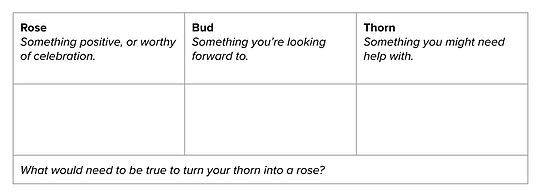
  • Develop students’ capacity to accept and embrace all emotions (including unpleasant ones). Consider using a feelings wheel to help students acknowledge and label their feelings. In addition, WOOP goal-setting and “Rose, Bud, Thorn Journaling” are two activities that can help students explore emotions while building resilience.
  • Rose Bud Thorn-1
  • Count Me Down, a strategy from Panorama Playbook partner Move This World, helps students identify ways that they are similar and different from others. For example, students might share three unique aspects of their family, two challenges they're currently facing, and one goal or dream they have.
  • Two Word Check-In is a quick way to take stock of students' emotions and feelings during the start or end of class (or during a community circle) in which students choose two words to describe how they are feeling. With younger learners, consider brainstorming a list of feelings or having students draw facial expressions.

Students must know that their voices are changing mindsets and shifting practices. This means taking action on your student feedback and SEL data. What are students telling you they need?

In the context of reopening school buildings, prioritization is key. Use the data to identify one to two focus areas that are high impact and highly actionable.


Observable Fish Moments at SV:

Be There: Thank you Carole, Miura, Julie, Sarah, Jen G., Cecily, Robin, Janice, Heather M., Daniel, Kristin, Kristi, Krista, Christina, Patty, Donna, Gloria, Carlos, Chloe, Fern, Janet, and Melody making our second week back with K-3rd students successful!
Play: Take some time to just relax and enjoy! Enjoy your spring break!
Choose your attitude: 
To actually choose how you respond to life, not just react, you must be intentional. Ask yourself throughout the day, "What is my attitude right now? Is it helping the people who depend on me? Is it helping me to be most effective?" NO EXCUSES!!

Make Their Day:  Thank you for being creative when lesson planning for your students.