Friday, April 26, 2019

April 26, 2019

A Teacher’s Success Story in FSUSD: (From Kristen Witt's newsletter)
I have a student who never turns  in any work (almost literally), is often late to class and is generally just insubordinate.  Some might look at him as a BIG problem on campus--I think I did. This student wouldn't even shake my hand.  
I was often at my wits end on how to reach this kid.  I can honestly say that I was ready to give up and just let him fail.  I witnessed another adult on campus treat a similar student with compassion and figured I owed it to him to give it another try.  
I can't pinpoint what it was exactly that I did--other than change my attitude towards him. I didn't confront him, nor did I lambast him (which he probably deserved)--I made a point to be positive and calm--it was tough.  I didn't continue to point out all of the things he was doing that were incorrect/out of line. He must've seen it or been in a place where he could see it and understood. What happened next surprised me--Recently on a Monday morning he showed up on time and shook my hand.  That day he turned in an assignment! Since then he has turned in a number of assignments and they were even well thought out and complete. He had not turned anything in for months. He didn't become an angel, nor has he turned in every assignment--but he has turned in most and he is now participating.  He is respectful and is not causing as many disruptions and I am very thankful that I was open to learning that even the seemingly unreachable can be reached. I am left with the understanding that I made a difference and that this student has made a difference in me too. He has helped me remember that some students need me to not quit on them.  It seemed like I gave him 100 chances--when he needed 101.
I am reminded that these kids can change and will change if we give them the chance.  

A Letter to Teachers From “That Kid”

( From Amy Chavez's newsletter) 
Dear Teacher,
I’m that kid. The kid who gets under your skin. The first grader who colors on your walls and spits on my table partners. The high school junior who mouths off and smirks from the back row. The child who knows exactly how to push your buttons, and does. Regularly.
I taunt. I terrorize. Sometimes I hit. I destroy. I curse. Rolling my eyes often seems like my favorite thing to do. I talk back. Maybe I’ve even made you cry a few times.

Don’t take my behavior toward you personally.

I know that doesn’t make any sense, since it’s mostly directed at you. But you know that old saying about having a bad day at work and going home and kicking the dog? Well, you’re the dog.
(I didn’t mean that the way it sounded.)
I really am a good kid deep down. There are so many things I care about. I have skills and strengths that I want to use to help other people. In fact, I secretly want for you to know all these good things about me.

But unfortunately, you don’t get to see these good things.

I am afraid. I am in pain. You know how if you put oil and water in a container together, the oil will float to the top? It’s like my fear and pain are the oil, and all the good things about me are water. Every once in a while, you might shake me up and see just a glimpse of those good things on the surface, but no matter how hard I try, the fear and pain will bubble up and cover everything again. It’s easy to think that the way that I react to fear and pain—the anger, the defiance—is the real me. In fact, I’ve even started to believe it.
The fear and pain I feel is different than what you may think. It’s not always actual physical fear or pain (though sometimes it is). I might be afraid that I’m not worthy of love, since my dad left me and my mom after I was born. I might be afraid that I will grow up to be like my mom, who is an alcoholic and misses all my baseball games. Or I might be in pain because my family and culture say I’m not manly enough since I cry a lot and am not really into sports. I might be in pain because someone who is supposed to love and protect me said something deeply hurtful that I won’t ever forget.
Maybe you look at me and think there’s no excuse for the way I behave. You might think, “This child has a stable family, loving parents, and a secure environment. I know kids with a lot less who behave perfectly fine.”

But please remember that there is always more than what you see.

What you might not know is that the pressure to be perfect or different than who I am is so intense and crushing that I believe I’m a failure, and I’m too scared to tell anybody that.
Or maybe my home life is fine, but I’m learning a very dangerous message—that I’m inadequate, unlovable, or not worthy of belonging—in some situation outside of home, or inside my own head. Maybe something is going on, or has happened, that nobody, not even my parents, knows about but me, and I do a really good job of faking that I’m happy or that I don’t care.
I know that I’m making things hard for you. I know you don’t deserve it. But I feel like you should know this: Somewhere, on a level I’m not even aware of, I’ve chosen you to behave this way toward because I know you’re a person who can help me.

This is a cry for help.

I want the same things everybody else does, but I’m asking for it in the most confusing and unflattering of ways.
I don’t know how to fix all of this (or I would have already). And I don’t think it’s necessarily your responsibility to fix me. But here’s how you can help me.
Start small. I’m fragile, and I’ve been hurt. Because I’ve got so much junk at the surface, maybe don’t try to remove it all at once or ask me to open up right away about my fear and pain.

Show me that you notice me—not my behavior, but something about me.

Ask me questions.
Don’t give in when I try to rile you up.
Maybe, slowly, I will learn to trust you. Or maybe I will take a long time, and you won’t see any progress in our time together, but your patience and kindness toward me will plant a seed that will sprout many years later.
But please, please, please don’t give up on me.
Love,
That Kid

SBAC Celebration on Monday:
Come prepared with your list of names that you will be reading. I will read perfect scores first. We will start with 3rd grade. Former grade level teachers go up and read the names of their students from last year together. Read ELA first Proficient/Advanced, then read ELA band jumpers. Students stay up front. Read Math next Proficient/Advanced, then read Math band jumpers. All students stay up front until all names are read for each grade level. If you have a new student in your class this year, you will be reading their name and recognizing them. 

Mrs. Merodio's last day will be on Tuesday. Thank you for going above and beyond to meet your students needs and even meeting with those students who are not part of your daily groups. We appreciate your dedication to our school!

Observable Fish Moments at SV:
Be There: Thank you staff for making our front office staff feel appreciated for ALL they do!! Thank you Heather H. and Kristin for helping out the front office.
Choose your attitude: 
To actually choose how you respond to life, not just react, you must be intentional. Ask yourself throughout the day, "What is my attitude right now? Is it helping the people who depend on me? Is it helping me to be most effective?" NO EXCUSES!!
Make Their Day:  Thank you Daniel for always stepping up and going the extra mile. Thank you Ariel and Carole for our fun spring sing concert.
Play: Thank you for making it a fun day for our office staff all week long.

Thursday, April 18, 2019

April 18, 2019

Focus as a district for elementary education next school year will continue to be an expectation for small group instruction and academic discourse

What is Small-Group Reading?

Small-group reading is an assisted literary experience in which the teacher supports and guides students on their instructional level before, during, and after reading. The instructional level of students is assessed through teacher observation and ongoing evaluations such as informal reading inventories. This flexible, small-group setting allows the teacher to match students’ reading abilities to appropriate reading materials, observe students’ reading behaviors, and model specific reading behaviors and strategies in context. Each small group consists of two to six students who are reading on the same level or have the same instructional need. The teacher helps students develop an understanding of the text and prompts them to apply strategies to monitor and improve their comprehension.
The goal of small-group reading is to develop independent readers who think about what they are reading and know how to use a variety of strategies to gain and maintain meaning before, during, and after reading. Small-group reading is a time for students to take on more responsibility for their learning with the teacher as a safety net. She scaffolds, supports, and challenges students’ learning through explicit use of instructional texts. Students read assigned text silently while practicing the strategy or strategies. Then they discuss their thinking, all the while becoming better readers and building confidence and self-esteem about themselves as readers.


Please read FSUSD update on negotiations with FSUTA https://bit.ly/2UEJdaO

*Progress Reports: due to me on April 26. Progress reports visible to parents May 3.

SBAC testing begins May 6th.

Observable Fish Moments at SV:
Be There: Thank you Annette for leading our Battle of the Books today. Thank you Vicky for planning all in day today!! Thank you Cecily and Sarah for attending the reclassification ceremony on Tuesday.
Play: Love all in days! Such a fun way to greet students in the morning.
Choose your attitude: 
To actually choose how you respond to life, not just react, you must be intentional. Ask yourself throughout the day, "What is my attitude right now? Is it helping the people who depend on me? Is it helping me to be most effective?" NO EXCUSES!!

Make Their Day:  Write a positive note to a student and make their day!

Friday, April 12, 2019

April 12, 2019

How to Coach for Equity (from a blog)
I want to offer some concrete ways in which we can coach teachers and leaders
within our education system to build more equitable classrooms and schools. This blog will
discuss what you see and where you look.
It's What You See
Where does your gaze settle when you walk in to a classroom? Is it on the teacher and
whatever he/she is doing? Is it on the students who are on-task or off-task? What draws
your attention?
As a coach for equity, I scan the room for any child who seems left out, cast out, under-served
or under-performing; for those who are socially, emotionally or academically not succeeding;
for the vulnerable who need us to huddle around and help them get through childhood.
Those are the children I look at first. I also see through a lens of power and systemic
oppression because my gaze lands first on the children who may come from communities
that have been disenfranchised for centuries, the children who may have more hurdles to
jump across.
Then I pay attention to how the person with authority (usually the teacher) relates to these
children. These highlight the first two indicators of equity in a classroom. I have been in
more classrooms than I can count where when I walk in the door, the first thing I see--right
by the door--is a "time out" chair occupied by a black or brown male. The inequity stares
me in the face. The symbolism of being by the door calls for a re-labeling of so called
"drop outs"--I see those who may one day drop out being pushed out in the first, third,
fourth grade. I have seen the same in the front office of many schools-- black and brown
boys (and a fair number of black girls) also being pushed out, waiting to be picked
up because of a behavioral infraction. As a coach for equity, I take note of this.
When I go into classrooms, I also notice the following:
• Who is the teacher calling on? And are those students the "successful" ones? Or are they
from the group of disengaged boys in the back of the class? And what is the nature of that
interaction between the teacher and the students? If the teacher does call on one of those
boys, is the interaction positive, neutral or negative?
• If students are doing group work, is every child meaningfully involved? Do they all have
input into the work? Do they each contribute? Are each child's contributions appreciated
and valued? How do students speak to each other? And are any students treated differently
because they are perceived as being different?
• English Learners struggle in many ways when their learning needs aren't met. So I pay
attention to how they are given access to the content and curriculum, how their specific
language needs are met, and perhaps most importantly, whether they speak at all. We know
that ELs need to speak a lot to become proficient in English, but I've been in dozens of
classrooms in dozens of schools where many ELs can go an entire week without a single
opportunity to speak. So I notice--who speaks? What do they say? How does the teacher respond?
This is a great article to read. CLICK HERE MY FAVORITE QUOTE FROM THE ARTICLE "I CAN UNEQUIVOCALLY SAY THAT RIGOROUS INSTRUCTIONAL PLANNING IS THE KEY TO IMPLEMENTING EQUITY." This quote speaks to me because as teachers we can make the difference in a child's life. This article and our focus on EL and SED in our SPSA for 2019-20 addresses equity.
Observable Fish Moments at SV:
Be There: Thank you Melissa for leading our Battle of the Books. Thank you Jennifer for planning our Academic Olympics.
Play: Thank you for taking pictures with our #butterflyeffect
Choose your attitude: 
To actually choose how you respond to life, not just react, you must be intentional. Ask yourself throughout the day, "What is my attitude right now? Is it helping the people who depend on me? Is it helping me to be most effective?" NO EXCUSES!!

Make Their Day:  When was the last time you had lunch with a student? Make their day by eating with a student and finding out much more about them :)

Friday, April 5, 2019

April 5, 2019

Congratulations Mrs. McGuinness!! 


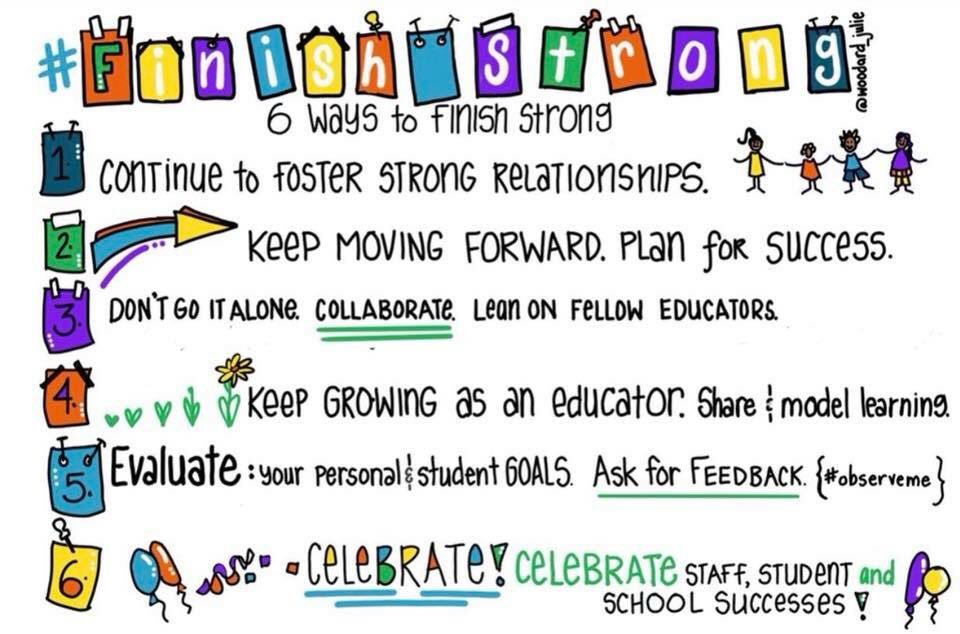
How do we #finishstrong?!?!  I know we are tired.  I know we are stressed.  I know there is a lot of pressure.  I know we ALL have things going on outside of SV.  I also know that we are here, with each other (and awake usually), more than we are with our families. So, again, HOW do we FINISH STRONG and encourage others to do the same??  Well, I think the pic above nails it.  Mic drop.  Keep Moving.  Plan for success. COLLABORATE.  Grow as an educator. Evaluate your goals and ask for feedback.  

CELEBRATE CELEBRATE CELEBRATE!
Celebrate YOU!  Celebrate YOUR/OUR STUDENTS!  Celebrate PARTNERS at SV!


504 Reminder:
Section 504 requires recipients to provide to students with disabilities appropriate educational services designed to meet the individual needs of such students to the same extent as the needs of students without disabilities are met. An appropriate education for a student with a disability under the Section 504 regulations could consist of education in regular classrooms, education in regular classes with and supplementary services.

Just a quick review on 504’s.  A 504 is a function of general education. It does not work like an IEP, it does not have a case manager. Once the 504 is given to the teacher it is the teacher’s responsibility to make sure it is followed because a 504 is part of general education. Because a 504 is part of general education it has to be attached to your sub plans every time and the medical plan if the 504 refers to it. If you have any other questions regarding 504’s please let me know.

Walk Through Data in March 


Observable Fish Moments at SV:
Be There: Thank you 7th grade team for the yummy treats at our staff meeting. Thank you Heather M. and Kristin for finishing our butterfly mural.
Play:Plan a fun activity for your class
Choose your attitude: 
To actually choose how you respond to life, not just react, you must be intentional. Ask yourself throughout the day, "What is my attitude right now? Is it helping the people who depend on me? Is it helping me to be most effective?" NO EXCUSES!!

Make Their Day:  When was the last time you had lunch with a student? Make their day by eating with a student and finding out much more about them :)


Thursday, March 21, 2019

March 22, 2019


As we head into Spring Break, please take time to reflect, relax and rejuvinate as we are about to head into the busiest time of year with testing, activities, 8th grade promotion, stress, events, and more.  

How do we, as educators, take a step back and avoid burn out (which usually happens around this time for teachers AND students!) so that we are still on top of our game?  Take a look at THIS ARTICLE for 10 EASY choices that you can make to help avoid burn out.  From choosing to be mindful to choosing to disconnect to something as simple as getting outside, it's an easy peasy read to help make your life less stressful and more focused!


This video gives a great example on a very visual process for students to organize their writing. Please watch this video!! Check out this video 


Writing aligned to the Common Core and the needs ofEnglish Learners

As we continue to focus on the needs of our English learners, it is important to continue to examine how instruction is differentiated.  This article from Larry Ferlazzo and Katie Hull Sypnieski provides an overarching view of writing.  The article discusses the three types of writing in the Common Core: Argument/Opinion, Information/Explanation, and Narrative.  The author's highlight the integration of reading with writing, especially for Argument and Information writing.

The article provides some specific implications for English learners and writing.
  • Create meaningful opportunities to communicate ideas rather than focus on grammar and conventions
  • Provide support for citations
  • Provide modeling and guidance
  • Provide many sentence starters and graphic organizers
  • Use collaborative writing projects
  • Support students in self-assessment and goal setting 
The article is part of a series.  Part 2 provides more specific strategies including 12 guiding questions to help students when writing.


Observable Fish Moments at SV:
Be There: Thank you Mr. Pringle for organizing our college guests to speak to every classroom!! Thank you Mr. Kimble for always going the extra mile and helping out whenever you can. Thank you 4th, 5th, 3rd, and 6th grade teams for coming to academic conferences prepared.
Play: Take some time during spring break and play.
Choose your attitude: 
To actually choose how you respond to life, not just react, you must be intentional. Ask yourself throughout the day, "What is my attitude right now? Is it helping the people who depend on me? Is it helping me to be most effective?" NO EXCUSES!!

Make Their Day:  Thank you Katie, Heather, and Jamie for planning a fun AR party for students!!

Friday, March 15, 2019

March 15, 2019


CLICK HERE to check out the website 
Tasha Wahl is an artist, philanthropist and businesswoman. She wanted to start a micro-philanthropy movement that embodied a concept popularized by Mahatma Gandhi: “Be the change you want to see in the world.” Tasha’s life-sized butterfly installations can be seen all over the world and have been photographed across the nation. Tasha knows that through small, contagious acts of generosity, the world could become a better place. We received a grant (thanks Kristin) to place the butterfly in our MPR room. The Butterfly Effect recognizes that we can be the change we want to see in the world by facilitating small acts of kindness, encouraging generosity, and promoting creativity. Our students are making poor choices and not being kind to each other. I am buying each grade level the book Andy Andrews The Butterfly Effect. We do PBIS, RJ, community circles and teach character education. Even with all of this our students are being mean to each other. I would like to come together as a school and teach our students to BE THE CHANGE. They are the only ones who can make this change one student at a time. During your community circles have students recognize how they could be part of this change. During spring break Kristin and I will be painting it on a wall in the MPR. If you would like to help let me know.
Please watch our videos to learn about social butterflies and the Butterfly Effect. 
If Not You, Then Who? The Profound Power of One Small Action
A Butterfly Observed: How One Small Idea Sparked Worldwide Change


From Mr. Pringle:
As you know, next week is our College Week at SV. Check your email for spirit week calendar for all to view. We're encouraging student & staff participation. Also for the K-8 teachers, College Students will be here next Friday (Mar 22) during the morning to speak to respective classes. The schedule is being coordinated and will be sent out soon. 

Additionally if you choose, here are a few simple activities for your students to participate in geared towards college information/readiness. 

*College Bingo Game (Peter has sheets)
*Virtual College Scavenger Hunt (Peter has sheets)
*Design a College Pennant (Peter has the paper)
*Mascot Trivia (Peter has sheets)
*Door Decorating (college of your choice)

Please welcome Maiya Williams who will be working with Chris Crawford as a para educator from 9:00-12:30 M-F. She will be starting on Monday. If you see her on campus please introduce yourself. 

Observable Fish Moments at SV:
Be There: Thank you Michelle and Melissa for meeting with me for academic conferences. Thank you Sarah for making sure every student's picture will be in the yearbook!!
Play: Have a great weekend!
Choose your attitude: 
To actually choose how you respond to life, not just react, you must be intentional. Ask yourself throughout the day, "What is my attitude right now? Is it helping the people who depend on me? Is it helping me to be most effective?" NO EXCUSES!!
Make Their Day:  Hand out caught you doing something right tickets like CRAZY!!!

Thursday, March 7, 2019

March 8, 2019


 This is from last year BUT a great reminder for our students. A teacher, Marcey Raymond Kusper, had her students discuss school protests to honor the 17 victims of the Florida shooting. One of her students said, "I think it's stupid. How about you make friends with 17 kids you normally wouldn't instead of walking out of school." She said a great conversation took place in her classroom. Students said smile at 17 people you normally wouldn't smile at, say a kind word to 17 people who might not have someone to speak to, open up your heart to 17 people who might be hurting, offer friendship to 17 people who might have had none. Now that could change the climate of the school. 17 reasons for change . . . 17 reasons to make a difference. What is your 17? I like that slogan. Our students at SV are reporting that students are being mean to them during recesses. How can we teach our students to be kind to each other? BTW this is happening at all grade levels at Suisun Valley :(
At SV we hold community circles weekly or daily depending on the need of our classes, we teach character education lessons daily, we hold RJ circles, we have implemented PBIS. Please reflect on these practices if your class is having a difficult time during unstructured time. What processes can you refine to better support your students. REMEMBER behavior does have to be taught and modeled. 

The staff room will be used by Chris our RSP teacher on the following schedule. If you have prep time you can still be in the staff room to work if you would like to. 

M,W,F days during the weeks below:


March 4
March 18
April 8
April 22
May 6
May 20
June 3
T, Th during the following weeks below:
March 11
April 1
April 15
April 29
May 13
May 27


At the staff meeting I misspoke and said that busing will stop for CHOICE kids. Choice kids will have busing until they have finished their time at SV through 8th grade. 


Observable Fish Moments at SV:
Be There: Thank you Sarah, Cecily, Carole, Ariel, Christina, Patty, and Julie for being prepared for academic conferences.
Play: Have a great weekend!
Choose your attitude: 
To actually choose how you respond to life, not just react, you must be intentional. Ask yourself throughout the day, "What is my attitude right now? Is it helping the people who depend on me? Is it helping me to be most effective?" NO EXCUSES!!
Make Their Day:  Have lunch with a student who is having discipline problems during unstructured time. Giving this extra attention could change their attitude.